
The traditional ‘study once, work forever’ model is gone. Universities must enable workers to return to learning throughout their careers.
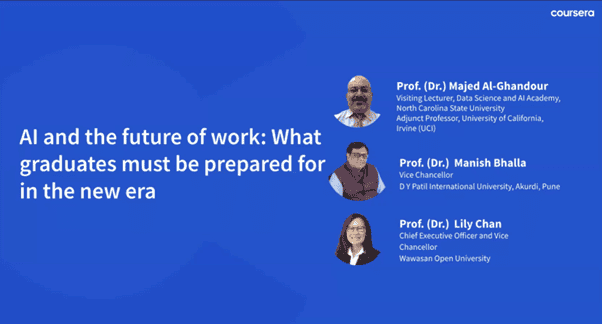
In her virtual session at the Coursera webinar on Artificial Intelligence (AI) and the Future of Work on 11 March 2026, Prof Dr Lily Chan, Chief Executive and Vice Chancellor of Wawasan Open University (WOU), said graduates must be prepared to navigate a new era of work where careers are shaped by continuous learning.
Speaking to a regional audience of educators, learners and industry leaders, she noted that in an AI-powered world, the ability to learn, unlearn, and adapt is essential.

Malaysia’s own economic landscape offers a vivid example. Geopolitical shifts have spurred growth in semiconductor manufacturing and data centre activity, generating strong demand for skilled professionals.
“There is a dire need to train Malaysian students to fill the jobs created by these industries,” Prof Chan noted, emphasising that the country’s economic advantage depends on education that keeps pace with workforce needs.
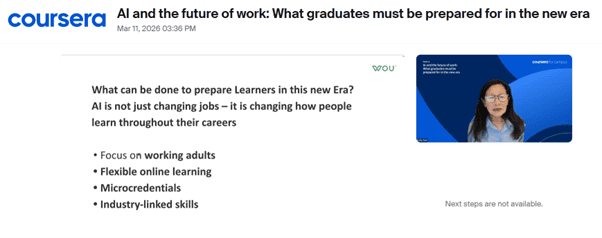
“AI is not just changing jobs and how jobs are done — it is also changing how people learn throughout their careers,” she said. “The real challenge is whether universities can reinvent fast enough.”
“We focus on flexible online learning so learners can acquire both a degree and industry-linked skills,” Prof Chan explained.
She outlined several pillars that underpin the University’s approach.
First, AI literacy must extend across the entire institution. “AI literacy is for everyone — not just students. Our staff must also understand how AI is transforming work and learning,” she said.
Second, the University is advancing modular learning pathways, where microcredentials can stack into full academic qualifications, allowing learners to progressively build expertise as their careers evolve.
Third, WOU emphasises strong industry integration, working closely with companies and global technology platforms to ensure that programmes reflect real workplace needs.
These principles are reflected in several initiatives highlighted during the session:
- Microcredentials stackable to a master’s programme, developed with Coursera, enabling learners to build specialised expertise at their own pace.
- Industry Partnership for Workforce Transformation, where WOU Academy collaborates with sectors such as smart manufacturing and IoT in Penang to co-design skills training aligned with industry demand.
- Degrees integrated with global industry certifications, giving graduates recognised credentials from technology leaders such as IBM, Google and Meta that signal job readiness alongside academic qualifications.
- Data and Digital Skills programmes designed to equip working adults for roles that require data-driven decision-making, AI-supported workflows and digital business transformation. In the emerging AI economy, Prof Chan noted, every profession is becoming partially — if not fully — data-driven.
Addressing a question about AI competencies for students in the arts, humanities, and social sciences, Prof Chan emphasised practical application rather than deep technical mastery.
“AI is an enabling tool that crosses all borders. Technical students may go deeper, but for others it’s about learning how to use AI as a tool in their everyday work. It’s so important in today’s work culture to have additional tools that help you think better and focus better in your work.”
Returning to her central message, Prof Chan stressed that workers will increasingly revisit learning throughout their careers — and universities must evolve to support this journey through flexible, lifelong learning pathways such as APEL, microcredentials, and continuously updated learning platforms.