
“AI is not replacing educators; it is empowering us to design adaptive, engaging, and learner-centred experiences. A skills-first future is about enabling every learner to participate meaningfully in the evolving world of work — and WOU is proud to help lead that transformation.”
– Prof Dr Lily Chan, Chief Executive and Vice Chancellor
As artificial intelligence (AI) continues to transform the world of work, higher education is being challenged to move beyond traditional teaching models and embrace learning that is agile, data-driven, and deeply connected to industry needs.
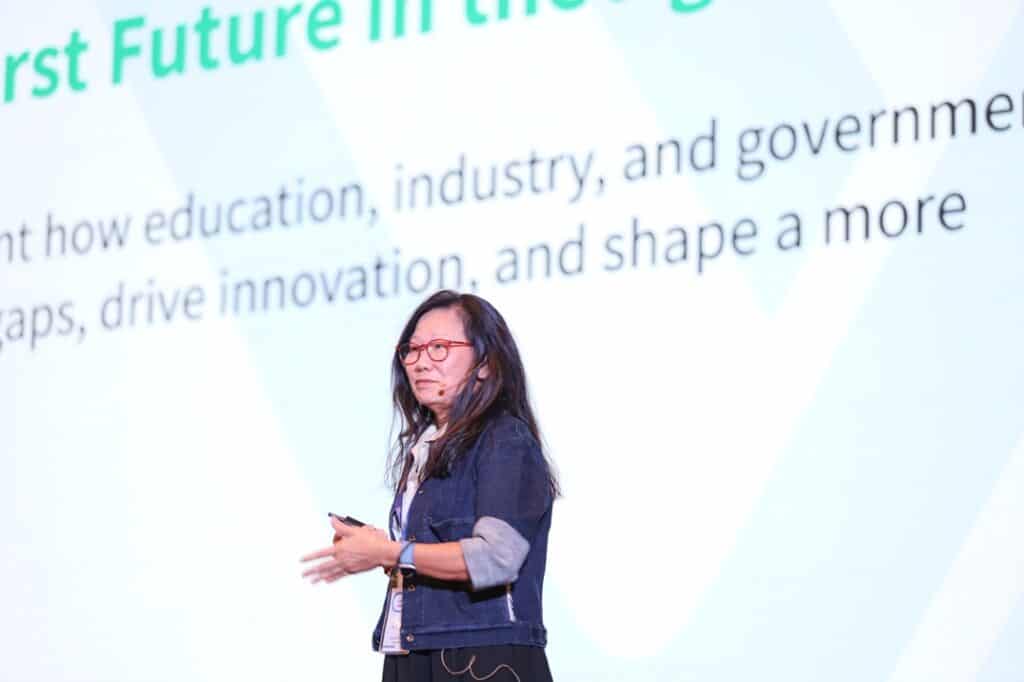
At the Coursera Connect Bangkok edition on 7 October 2025, Prof Dr Lily Chan shared how Wawasan Open University (WOU) is responding to this transformation during a high-level panel on “Human + Machine: Reskilling and Learning in the Age of AI”.
The discussion explored how universities are personalising learning experiences and supporting faculty at scale, while companies are building future-ready teams through strategic reskilling. The regional event, themed Transforming Learning in an AI-Powered World, brought together over 100 senior leaders from higher education, government, and industry across the Asia Pacific.
“Education, industry, and government must work together to bridge skills gaps, drive innovation, and shape a more equitable future of work,” Prof Chan asserted.
She highlighted how WOU’s skills-first education model is designed to meet emerging workforce needs while aligning with Malaysia’s National Semiconductor Strategy (NSS) — a key initiative aimed at strengthening the nation’s high-tech and AI-ready talent base.
Prof Chan explained that WOU’s transformation builds on its strong foundation in open and distance learning (ODL) and leverages technology and partnerships to deliver flexible, future-focused programmes.
Central to this effort is the University’s collaboration with Coursera in embedding credit-bearing, job-ready microcredentials within its academic curriculum.
According to Prof Chan, WOU has harnessed Coursera’s AI-powered Course Builder to design over 50 custom courses, contributing approximately 30% of total programme credits. Covering Software Engineering subjects such as Data Structures and Algorithms, Machine Learning, and Computational Logic, along with microcredentials in application development, these courses integrate industry-recognised content and professional certificates to equip learners with in-demand competencies that support the talent development needs of industries and corporations across the region.
She noted that this skills-first approach provides learners with multiple pathways for progression. “Microcredentials provide students with the optimal pathway for both educational advancement and career growth. They are stackable towards a degree, or can stand alone as short courses for upskilling and reskilling.”
Reflecting on WOU’s inclusive learning pathways, Prof Chan highlighted how they continue to open doors for career-driven individuals.
“Nearly 90% of our students are working adults — primarily Millennials and Gen Z — and about half of them enter through the Accreditation of Prior Experiential Learning (APEL) system. This recognition of prior learning enables individuals without conventional academic qualifications to pursue diplomas, degrees, or postgraduate studies through structured, flexible pathways.”
She added that AI-driven course design and adaptive learning tools have further enhanced learner engagement and ensured that WOU’s curriculum remains responsive to evolving industry needs.