
Artificial intelligence (AI) has become a central theme in global discussions on technology, economic growth, and geopolitical competition.
In his commentary published in The Star, Tan Sri Andrew Sheng reflects on the rapidly evolving AI landscape and the questions it raises for individuals, businesses and policymakers.
From geopolitical rivalry and economic productivity to jobs, ethics, and environmental impact, he examines the forces shaping the AI era. Drawing on historical analogies—from gold rushes to industrial revolutions—he highlights how AI could create opportunities for growth, sustainability, and innovation if data, infrastructure, and tools are made more open and accessible.
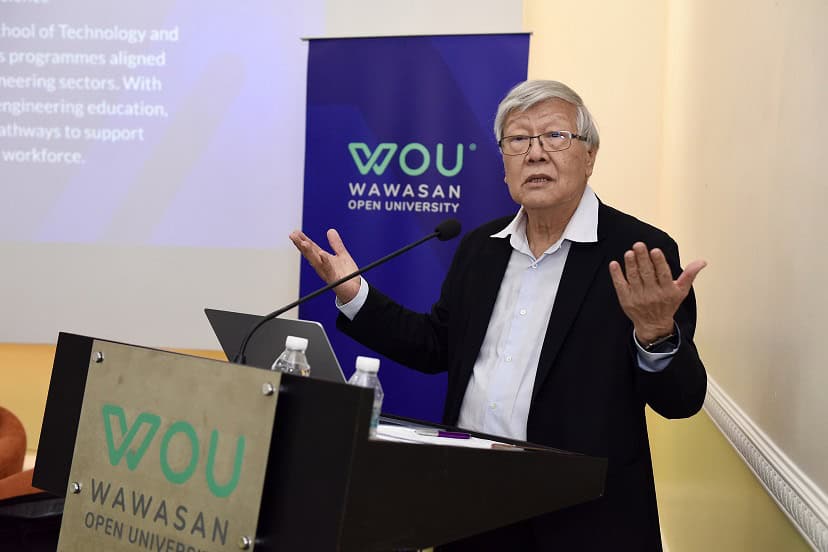
Tan Sri Andrew Sheng is Chairman of Wawasan Open University’s (WOU) George Town Institute of Open and Advanced Studies (GIOAS), where he contributes thought leadership on global economic and technological developments. A globally respected authority in financial governance and economic strategy, he has advised governments, central banks, multilateral institutions, and global regulatory bodies on market transformation during periods of technological disruption and geopolitical change.
AI in the Layman’s Eye

THE subject of artificial intelligence (AI) has become so dominant that the World Economic Forum in Davos recently reputedly devoted 200 sessions for corporate leaders to discuss AI from multiple angles.
The conversations focused on five key themes – the geopolitical rivalry using AI and technology; AI as a productivity and growth driver; AI as a job disruptor; how to invest in AI talent; ethics and governance for generative AI and robot systems; and the environmental footprint from using AI, consuming huge amounts of energy and minerals.
Underlying these themes are the layman’s questions: Will the United States or China win the AI race? Is there an AI bubble or is it overstated? How can companies and nations use AI to create, coordinate and capture value for me as an individual and for collective humanity?
Firstly, the answer to the question of who wins the AI race is at best an opinion. The facts are not fully known and change by the day.
Throughout my two-decade experience as an opinion editor writer, I tried to be as fact-or-evidence-based as possible.
When I started using AI, my editors told me that I must double-check the facts, as AI can hallucinate. That begs the question – do we check how a fridge works by going back to its parts?
Since the Ukraine war revealed that media on all sides cook up propaganda as facts and figures, who can believe media-generated “facts” anymore?
Newspapers today have become opinion providers, where “experts” pick and choose data to fit his or her own opinion over very complex situations.
You choose to believe not the facts, but the expert.
AI relies on machine-readable data, and if the data is wrong, the conclusions are wrong.
Relying on AI to interpret a real world that is far more complex and dynamic than any theory – with random factors that are seldom factored in – means that we cannot pre-state what the future will bring even with the best machine or expert.
We simply must accept that the interactively dynamic future creates multiple options with a whole range of outcomes. No one is fully in control of our future.
Former US National Security Adviser Jake Sullivan shrewdly observed in his Foreign Affairs article Geopolitics in the Era of Artificial Intelligence: “Washington does not need another prediction about the AI age. It needs a way to make choices under uncertainty – one that secures the United States’ advantage across multiple possible futures and adapts as the shape of the AI era comes into view.”
“The task for policymakers now is clear: treat AI not as a single story but as a shifting landscape,” he concludes.
Second, whether there is an AI bubble is also too early to tell. At Davos, Israeli historian Yuval Noah Harari likened AI to the Industrial Revolution, where it took generations for inventions like the steam engine, electricity and railways to diffuse and be better understood.
In new and exciting situations, people hallucinate through financial speculations like the Railway Mania Bubble of 1845, when there was excessive investment in railway tracks and stock.
My favourite historical analogies are the Gold Rushes of California (1848–1865) and Alaska (1896–1899).
The gold miners didn’t make that much money – it was the “shovel sellers” or suppliers of food and equipment to gold miners who prospered, like Levi’s that sold jeans to miners, and later to the mass middle class.
The parallel today is between AI large learning model miners like OpenAI struggling with huge investment commitments relative to smaller cash flow, compared with the hardware infrastructure providers like Nvidia and Amazon Web Services, who make billions by providing the chips and cloud infrastructure on which the models are run.
Third, how individuals, companies and nations deploy AI tools to enhance their own productivity and kick off growth and jobs will shape the economic landscape over the next few decades.
We cannot deny that AI and robotics have dual military-civilian use, with defence expenditure creating jobs and innovation in the short run.
However, if it is actually used in kinetic war, the ultimate result will be calamity and destruction.
On the other hand, if AI is used to improve resource usage efficiency through recycling, reforestation and carbon capture, this could be a race towards a more sustainable future.
Nvidia CEO Jensen Huang’s five-stack framework for AI tech systems usefully sees energy as the foundational layer – all AI systems rely on huge amounts of energy to drive data centres and computing.
The second layer comprises super-fast semiconductor chips that create the massive computing power needed for running the AI models.
The third is the physical infrastructure of data centres, telecommunication networks and software to run the computing and models.
The fourth is the AI models and training platforms that enable modelling and predictive power.
Fifth, applications will determine whether AI delivers real-world productivity and impact.
AI is a tool that continually learns, so agentic and generative AI models are already smarter than most human experts.
At the overarching level, AI is only as good as the data. All governments can help the layman to compete in the AI space by making data more accessible, timely, of higher quality and relevant to local contexts and users.
Ultimately, all data is local, but digitised data breaks down geographical barriers by allowing AI to “read” such diverse data to derive patterns that enable prediction or better analysis.
The biggest collectors of data are governments through different departments and agencies that hoard data, sharing it neither with each other nor with the public.
By making models, infrastructure, data and energy more open-source and democratically available, AI will become more diverse, creative and resilient. AI cannot be controlled by the few to mentally colonise the many.
The AI era is science fiction becoming reality. Agentic AI enables everyone to make our own Frankensteins, networked together in ways we cannot individually comprehend. We are creating our own futures, good or bad.
Embrace it or reject it – that is the individual choice. Life will always find a way.
This article was first published in The Star on 21 February 2026.
Original source:
https://www.thestar.com.my/business/insight/2026/02/21/ai-in-the-laymans-eye