
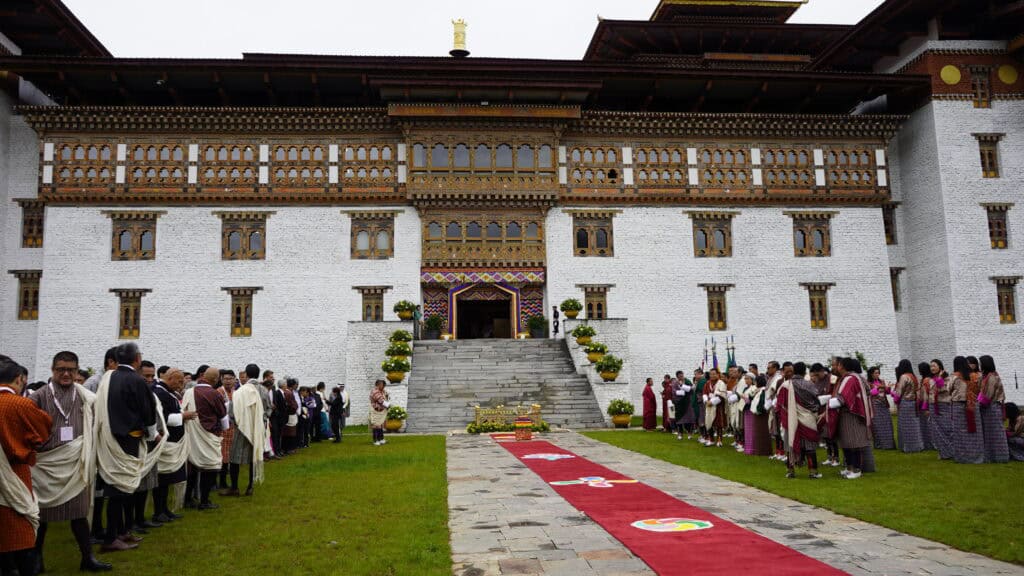
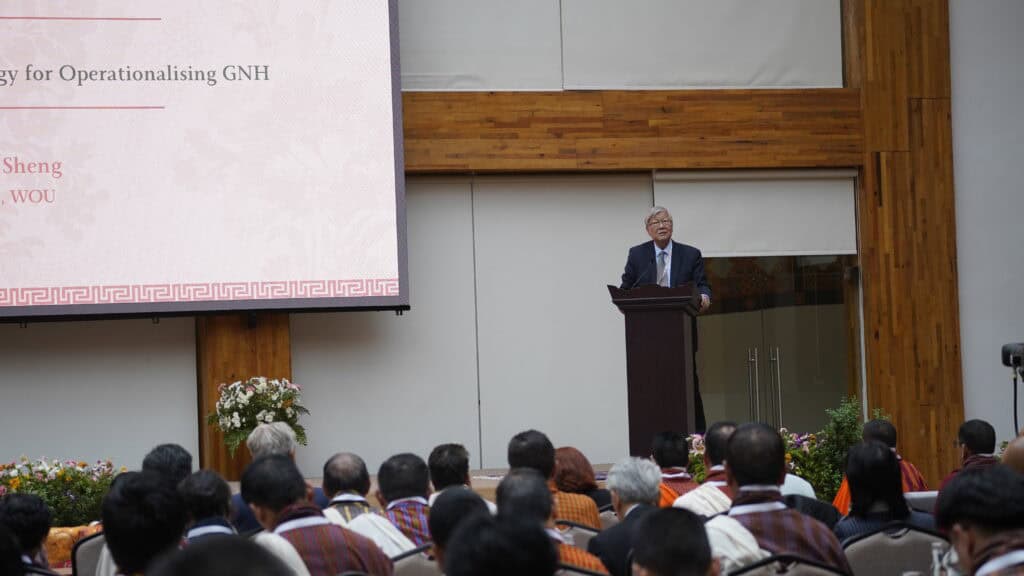
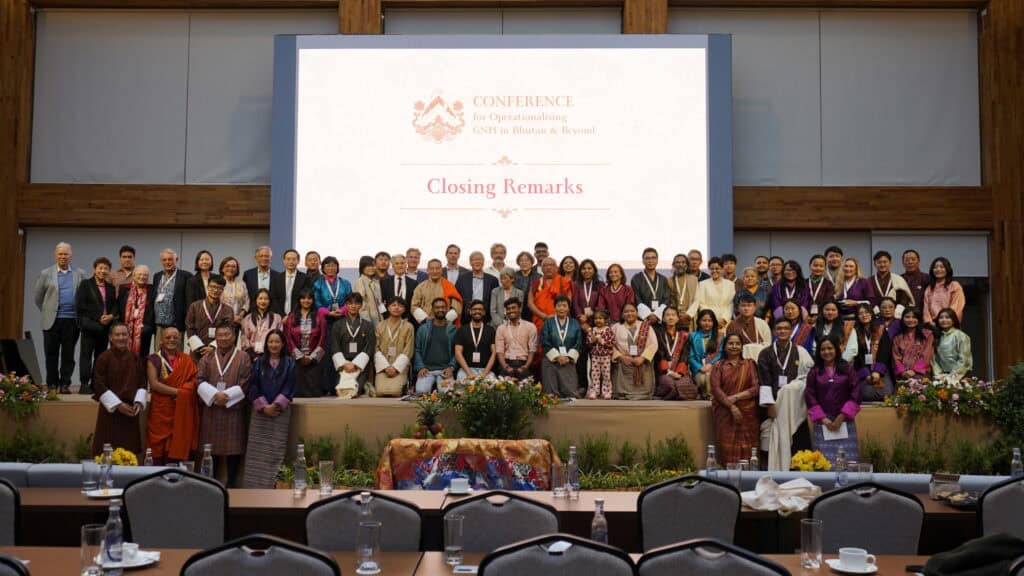
In June 2025, WOU’s George Town Institute of Open and Advanced Studies (GIOAS) partnered with the Tarayana Foundation to organise the Conference on Operationalising GNH (Gross National Happiness) in Bhutan and Beyond. Held at Bhutan’s famed Dungkar Dzong in Pangbisa, Paro, the two-day event on 19 and 20 June was part of a global conversation involving key leaders, experts, academics, and strategists on village-led development models, policy strategies, and ways to translate GNH into practical frameworks for socio-economic development.
In this Q&A, GIOAS Chairman and WOU Board member Tan Sri Andrew Sheng reflects on why the world needs GNH, and shares his views on the One Earth Balance Sheet and inclusive development — providing a compelling take on how values-driven approaches can shape our shared future.
What was the vision behind organising the “Conference on Operationalising GNH in Bhutan and Beyond”?
Simply put, the Conference aimed at taking Bhutan’s big idea of GNH, learning the lessons so far in implementing GNH and hopefully, scaling its work globally. Everyone admires GNH’s focus on well-being, culture, and nature over mere GDP (Gross Domestic Product), but the real challenge is transforming that philosophy into practical systems we can actually use in the contemporary world. I personally believe that GNH is the right way to go to deal with the big issues of climate change and re-thinking about social harmony and economic transformation.
Thus, we brought a diverse range of people together to figure out how to blend inner well-being (like resilience and compassion) with outer systems like education, finance, and digital tools to tackle big challenges like climate change and social inequality. These comprised many renowned Bhutanese experts, as well as foreign experts who have in-depth experience with technology, carbon credits, social stock markets and global creative commons. We specifically looked at carbon credits and models like Auroville and Ladakh living and education systems in India to see how to compare and contrast bottom-up development experience.
This conference was to find and share real, working models, especially at the village level, that put GNH into practice. We want to create adaptable tools and policies so communities everywhere can shape their own development, inspired by Bhutan, but built for their unique needs. It’s about making GNH actionable. We were very lucky to have local partners like the Tarayana Foundation with the patron, Her Majesty Queen Mother Dorji Wangmo Wangchuck, to make the event a great success.
Bhutan’s Gross National Happiness (GNH) framework has long challenged the global focus on GDP by prioritising well-being, sustainability, and cultural values. Why do you believe the world needs this kind of development model now more than ever?
The world is currently in a state of VUCA (Volatility, Uncertainty, Complexity, and Ambiguity) transition, with its climate shocks, resource pressures, and fragmented global systems. Such a condition demands a fundamentally different compass and approach. GDP alone can’t steer us through volatility where food, water, and stability are at risk, whilst inequality at people and planet levels are deteriorating. Worse, top-down frameworks like the UN Sustainable Development Goals (SDGs) are stalling (under 20% are on track) because they struggle to translate global goals into local action.
GNH offers a values-driven, holistic approach grounded in community, which is exactly what’s missing. It prioritises resilience and well-being, integrates ecological limits, and respects cultural context and emotional and spiritual values. As nations forge independent paths amid uncertainty, GNH’s focus on place-based, balanced development is a practical blueprint for navigating complexity and turning intention into impact where it matters most.
In your keynote, you described the One Earth Balance Sheet as a way to move beyond GDP by using real-time data and village-led governance to support well-being. How can this framework help communities take greater ownership of their development?
The One Earth Balance Sheet concept flips the script by putting real-time, local data directly in communities’ hands.After all,a global balance sheet is built up from the balance sheet of the smallest components, such as individuals, corporations or villages. A bottom-up approach requires us to have better understanding of what happens at the grass-root level. Instead of relying on distant top-down GDP metrics, grass-root villages track what they value most, assets such as clean water, forests, cultural heritage, and community health. This granular dashboard makes their unique assets and risks visible.
With this clarity, communities can be empowered to lead decisions like prioritising forest conservation over a mining proposal because they see the long-term ecological and cultural costs. The framework also strengthens local governance by integrating traditional knowledge with real-time data, where villages can be part of the design process for regenerative projects (e.g., agroforestry or micro-hydropower) that are aligned with their context.
The bottom-up approach does not conflict with the current top-down approach. At the national level, macro-decisions and policies have to be consistent and balanced. However, they must take into consideration high quality data feedback from the bottom levels. Ultimately, this approach shifts power from top-down planning to grounded action, turning abstract global goals into owned, local priorities. The world comprises countries that are divided into nations, provinces, cities and villages. But even large cities are conglomerates of villages. If villages are happy and healthy, so will the cities and nations.
In your view, how can we ensure that development is truly inclusive—socially, economically, and culturally?
To work towards true inclusivity, we must start by centring communities as the architects and operators and not the recipients of their future. This is a dramatic shift away from a top-down focussed approach where decisions tend to prioritise macro-level goals that are alienated from local conditions.
A bottom-up approach will need multiple moving parts. For starters, frameworks like the One Earth Balance Sheet which tracks real-time ecological health, cultural assets, and local wellbeing ensures that local priorities are what drive decisions, and not external agendas. Crucially, with advancements in digital technologies, we now have the ability to account for each individual’s well-being—making visible their aspirations, challenges, and contributions. This opens the door to truly personalised and inclusive development planning. Second, cultural values and ecological boundaries must be embedded into economic planning, and be made specific to each community. For instance, the “wealth” of a forest community would be different from that of a coastal town’s. Third, practical systems such as equitable finance and regenerative design must be paired with investments in mental resilience and ethical leadership. The villagers become owners, rather than on-lookers of their own future. At the national level, the state help to empower village communities to work together to cope with their own challenges and support with infrastructure, resources and finance. This approach, underpinned by human-centric digital ecosystems, is far more responsive and inclusive than prevailing top-down models of development.
What mindsets or skills do future leaders and professionals need to thrive in this shifting landscape?
Leadership will exist broadly across two levels which are interactive and equally important: top-down and bottom-up. In a future that centres bottom-up development, top-down leaders (e.g., policymakers, global NGOs) must cultivate humility in their leadership. This means a mindset shift towards deep listening, enabling, and devolving power as opposed to imposing solutions. It requires also deep observation, with data-based approach to decision-making. Top-down decisions must be sensitive to deep values within the society, culture, religion and traditions. Any solution designed by top-down leaders must put local data and priorities centre stage which allows them to subsequently take a step back.
Bottom-up leaders (e.g., village coordinators, local NGOs) will need grounded advocacy skills which will allow the greater articulation of community needs to power (e.g., translating cultural values for all stakeholders). They would also need to be able to mobilise collective action locally, and be literate in new technologies such as real-time balance sheets to drive context-specific solutions.
Both require inner resilience and ethical courage to prioritise well-being over extraction.
In Malaysia, development planning tends to be a combination of top-down and bottom-up approaches, but many rural and semi-urban communities still hold strong local knowledge, cultural identity, and social ties. Do you see potential for a village-led, grassroots development model—like the one discussed in Bhutan —to take root here? And how can higher education institutions or community-level education play a role in supporting this shift?
Yes, but Malaysia must decentralise power to really pursue a village-led, grassroots development model. The devolution of economic and political power is already happening at the state level. States like Sarawak and Johor are developing their own visions on how to develop the state within the Federal context. Some experiments are being tried, such as the Smart Omni Village pilot project in Sapulut, Sabah, but the primary obstacle is the lack of autonomy and understanding at the village level to pursue goals that are conscious of the needs and limits of their communities and environment. What is required then is the empowerment of villages by giving them knowledge, resources and funding, and allowing them to define priorities using new technologies as catalysts of change.
The Bhutanese model hinges on listening more to local wisdoms, co-sharing and cooperating with each other at all levels and leadership by example. Western-trained experts do not always know best in very diverse local conditions. It is through action-based learning that we blend modern technology with local, place-based wisdoms. For instance, architecture students could be learning how to fully utilise the building materials that exist in their areas (e.g., certain woods, compressed earth) rather than the “utility” of concrete, steel and glass which look modern, but consume more energy. Design cannot be divorced from local traditions. Having a holistic, local and national balance sheets will allow students to think about how to regenerate, conserve and protect, rather than take, make and waste. Universities and higher education institutions can train graduates who are context translators that can bridge local wisdom and policy and host living labs where solutions emerge from local needs rather than imported templates.
Malaysia has the potential to build a vibrant Malaysia Knowledge Network—an open, federated ecosystem of academic institutions, local practitioners, and communities—that contributes not only to national development but also to the Global Creative Commons. Such a network would make shared, place-based wisdom a vital part of our collective intelligence as a planet.
We learn to share values and co-create our communities together with innovation, technology and adapting to new conditions which are changing by the day. We will publish a book drawing from the excellent papers and useful lessons from the various keynote addresses and panellists, as well as the insightful feedback from the audience.
About George Town Institute of Open and Advanced Studies
The George Town Institute of Open and Advanced Studies (GIOAS) was established in December 2018 as an independent, not-for-profit institute that seeks to explore ideas and complexity within open societies. It operates as an integral part of Wawasan Open University, embracing the principle that progress is open-ended and that there are no boundaries, only the willingness to pursue knowledge in the furtherance of society and nature. GIOAS celebrates the vibrancy of George Town, a UNESCO World Heritage Site, in attracting thinkers, teachers, students and doers in the world of science, social science, business, government, and civil society. By providing a dynamic platform for thought leaders to connect, network, and exchange ideas, it aims to bring global perspectives into the ongoing dialogue in Penang and Malaysia on the evolving role of education, learning, work, and society.