
By Associate Professor Ts. Dr. Lee Yong Siang*, School of Technology and Engineering Science (STE)
Cities today face growing pressure to become more sustainable, resilient, and resource-efficient. As population growth, urbanisation, and industrial activity continue to increase demand for water, infrastructure, and waste management systems, the challenge is no longer only about providing urban services. It is also about how these services are planned, monitored, managed, and improved over time.
At the PDC Sustainability Conference 2026, organised by Penang Development Corporation in June, I had the privilege of addressing policymakers, industry leaders, academics, sustainability practitioners, and urban development stakeholders on the need to rethink how cities manage water, waste, and urban resources for long-term sustainability.

A key concern I highlighted was Malaysia’s high water consumption. Malaysia has one of the highest water consumption rates per capita in Southeast Asia, averaging 226 litres per person per day in 2023. This is a significant sustainability issue because high water consumption does not only place pressure on water supply. It also increases the cost of treatment, distribution, wastewater management, infrastructure maintenance, and long-term resource planning.
Urban sustainability challenges
High water use and the cost of underpricing
High water consumption is one of the clearest warning signs for cities. When water is priced very low, there may be little incentive to conserve. While subsidies help reduce the cost burden for consumers, they can also encourage wastage and make it harder for operators to recover the operational costs needed for maintenance and upgrades.
Non-revenue water and infrastructure losses
Another major challenge is non-revenue water, which refers to treated water that is lost before it reaches paying consumers. This can happen through leaks at pipe joints, ageing infrastructure, illegal connections, inaccurate meter readings, and losses during repair and maintenance works. The result is wasted treated water, weaker financial sustainability for water operators, and limited funds for service improvements.
River pollution and water security risks
River pollution adds further pressure to urban water security. About 81.2% of raw water is sourced from rivers, making the water supply system highly exposed to pollution risks. Around 30% of river stations have been rated at least “slightly polluted”, with industrial discharges, illegal dumping, and agricultural runoff among the key causes.
The impact of river pollution can be severe, as it may lead to water supply disruptions affecting households and businesses. The amendment to the Environmental Quality Act, which increased fines for water pollution offences from RM100,000 to RM10 million, is an important step. However, strong and consistent enforcement remains essential if such measures are to be effective.
Closing the urban loop
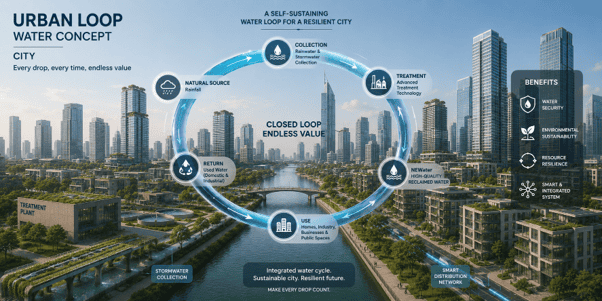
To address these challenges, cities need to move beyond treating water and waste as separate systems. The urban loop concept views them as interconnected flows that can be managed more efficiently and sustainably.
In this model, water is sourced, used, treated, and reused multiple times, while waste is collected, processed, and transformed into new resources. This reduces dependence on raw water sources, minimises landfill use, reduces pollution, and lowers operational costs.
The urban loop is therefore not only a technical solution. It is a different way of thinking about urban sustainability. Instead of focusing only on supply, disposal, and treatment, cities must also focus on conservation, recovery, reuse, and long-term system efficiency.
Sustainable drainage as part of city resilience
Sustainable urban drainage systems should also be part of this wider approach. As cities face climate impacts such as floods, droughts, and rising temperatures, urban water management cannot focus only on treated water supply and wastewater systems.
Drainage, stormwater, and flood management must be viewed as part of the same sustainability agenda. By integrating sustainable drainage principles into planning and infrastructure development, cities can better manage water flows, reduce pressure on drainage networks, and support more resilient urban environments.
This is especially important for cities that are growing rapidly, where land development, higher population density, and changing rainfall patterns can place additional pressure on existing infrastructure.
How smart systems support better management
Smart technologies can help cities monitor, manage, and improve water and waste systems in real time. These include smart meters for water consumption tracking, SCADA systems for wastewater treatment, IoT-enabled waste bins for fill-level monitoring, and digital twins that simulate networks to predict and prevent issues.
The benefits are practical. Smart systems can reduce water loss by 20% to 30%, optimise waste collection, and support cost savings of 13% to 20%. They also support wider sustainability goals, including SDG 6: Clean Water and Sanitation and SDG 11: Sustainable Cities and Communities.
Smart systems in practice
Several city-level examples show how this can work. Singapore’s “Four Taps” approach combines catchments, imported water, reuse, and desalination, supported by IoT sensors monitoring more than 5,000 km of pipelines. Singapore also reduced per-capita water use by 10% from 2000 to 2020.
In Penang, RM2.5 million has been allocated for 2,000 smart water meters under Phase 1 in Balik Pulau, with plans to scale up to 20,000 meters statewide. This forms part of a wider digital water management initiative to improve efficiency and reduce leakage.
Kuching also provides a useful example through intelligent leak detection using an AWS-powered IoT system and GIS data. Its smart water direction includes automated treatment plants, unified 3D GIS water network mapping, and telemetry for flood and tidal management through the Kuching Barrage.
Moving from waste disposal to circular economy
The same systems-thinking approach applies to waste management. A circular economy moves away from the linear “take–make–use–waste” model and aims to minimise waste while maximising resource use.
In waste management, this means treating waste as a resource. Materials can be recycled into new products, energy can be recovered from non-recyclable waste, and product life can be extended through repair and refurbishment. These strategies support sustainability goals and reduce environmental impact.
Penang has already demonstrated leadership by transforming waste management from traditional open dumping practices to engineered sanitary landfill systems and strong recycling performance. The next step is to move beyond disposal towards resource recovery, smart waste technologies, and circular economy solutions. With more than 2,200 tonnes of waste generated daily and about 80% sent to landfills, circular diversion strategies will be increasingly important to relieve pressure and create secondary material markets.
CopenHill in Copenhagen, Denmark converts 440,000 tonnes of waste per year into clean energy, powering 150,000 homes and providing heating for 120,000 households, while also creating public recreation value. Copenhagen’s circular waste system uses smart bins that can reduce collection trips by 50%, with waste-to-energy plants processing 60% of municipal waste.
In Malaysia, Bukit Tagar Enviro Park, the country’s largest sanitary landfill at 680 hectares, shows how landfill systems can evolve through methane-to-energy generation, SCADA monitoring, and circular economy initiatives, with 339 million kWh of renewable energy produced and 2.7 million tonnes of CO₂ equivalent avoided.
Using data to encourage sustainable behaviour
Infrastructure alone will not build sustainable cities. Data-driven strategies are also needed to encourage more sustainable behaviour among consumers, operators, and policymakers.
Smart meters, apps, IoT waste bins, and AI analytics can make consumption and waste patterns more visible. When users receive real-time feedback, they are more likely to understand their impact and adjust their behaviour. For operators, the same data can improve demand forecasting, reduce collection trips, optimise routes, and support better maintenance planning.

Challenges, opportunities and the way forward
There are still challenges to address. Smart infrastructure requires high initial investment. IoT systems raise data privacy concerns. Adoption may also be slower in developing regions where funding, technical capacity, and public readiness vary.
However, these challenges also create opportunities. Public-private partnerships can help support funding and implementation. Scalable smart system frameworks can make adoption more practical.
Green certification systems such as the Green Building Index (GBI) and Leadership in Energy and Environmental Design (LEED) can further support closed-loop practices, particularly through recycling, waste reduction, greywater recycling, and more efficient resource use.
AI-driven efficiency, blue-green infrastructure, and stronger community engagement can also help cities move towards more sustainable outcomes.
The future of sustainable cities lies in how wisely we manage every drop of water and every piece of waste. Closing the urban loop requires investment in smart systems, circular economy practices, sustainable drainage, data-driven decision-making, and public participation.
Water and waste should no longer be viewed only as operational issues. They are central to the resilience, liveability, and sustainability of future cities. Sustainability is not a choice; it is the foundation of how cities must grow.
About the Author
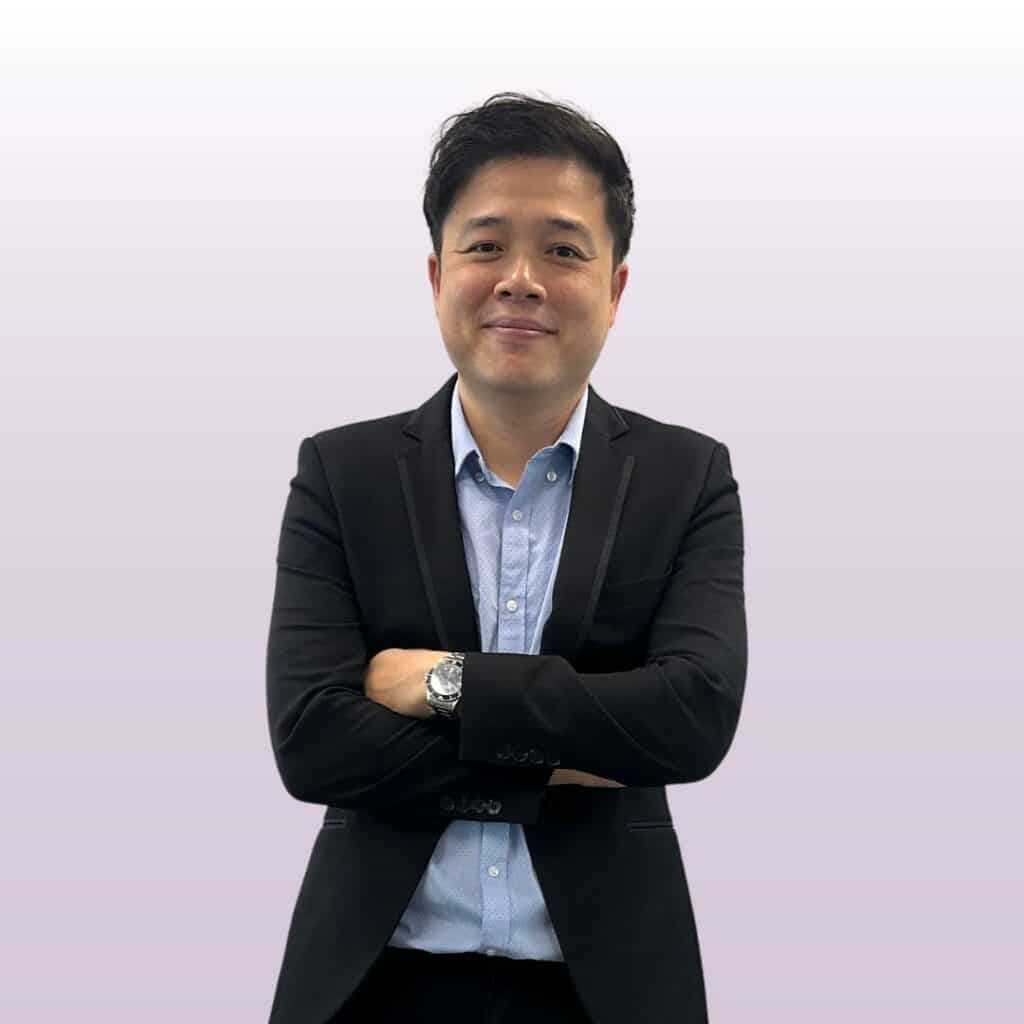
Associate Professor Ts. Dr. Lee Yong Siang is an Associate Professor and Deputy Dean at WOU’s School of Technology and Engineering Science. He holds a Ph.D. in Civil Engineering (Project Management) from Universiti Sains Malaysia and a Bachelor of Civil Engineering (Hons) from Universiti Malaysia Sarawak. With over 10 years of academic, industry, consultancy, and research experience, his areas of interest include sustainable construction management, circular economy, ESG, BIM, digital twins, artificial intelligence in the built environment, and digital construction. He is also a Professional Technologist, HRD Corp accredited trainer, QLASSIC Assessor, and researcher with over 30 indexed publications.