
Learn how to thrive in the age of AI by building the skills and mindset that technology alone can’t replace.
Artificial intelligence (AI) isn’t just changing how we work—it’s reshaping what it means to be employable, adaptable, and ready for the future. To help professionals, working adults, and lifelong learners navigate this shift, Wawasan Open University (WOU) hosted a webinar on 2 August 2025 titled When Intelligence Meets Intuition: The New Era of AI Collaboration.
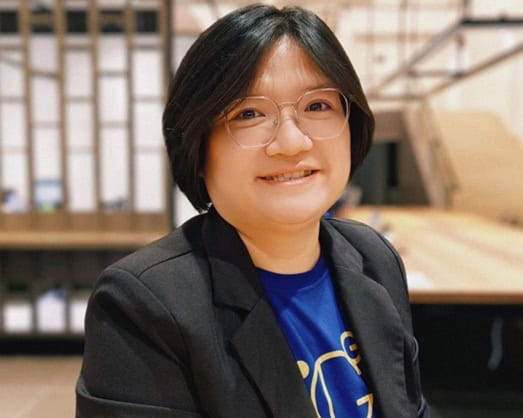
In this session, Grace Tok, Senior Lecturer at WOU’s School of Digital Technology (DiGiT), explored how AI is already embedded in our daily lives and industries—and more importantly, how we can work alongside it to elevate our careers and capabilities.
AI as a Collaborator, Not a Competitor
AI is no longer a futuristic concept. From Spotify’s music recommendations to AI-assisted diagnostics in healthcare, automated research tools, and intelligent learning platforms, the technology is already influencing our daily decisions and professional workflows.
Across industries, AI is handling routine, repetitive tasks, enabling people to focus on areas where human judgement and emotional intelligence are irreplaceable:
- Healthcare: AI aids in identifying fractures or disease, but it’s doctors who explain results and guide treatment.
- Customer service: Chatbots manage routine queries, while people resolve conflicts and empathise with customers.
- Creative industries: AI generates images, music, and content—but meaning, originality, and cultural relevance remain human responsibilities.
- Manufacturing: AI systems enhance quality and productivity, while human workers manage operations and real-time adjustments.
- Education: AI helps students achieve educational goals and supports learning analytics but educators ensure ethical use and provide personalised guidance.
While AI excels at data analysis and optimisation, it cannot replicate creativity, empathy, or intuition. When intelligence is paired with intuition, it creates a more balanced, impactful approach to problem-solving, innovation, and decision-making.
This synergy between human insight and machine intelligence will define the future—not just in tech-centric roles, but in any profession where decisions, relationships, and values matter.

AI Is Evolving—So Must We
On the talent front, the World Economic Forum’s Future of Jobs Report 2025 highlights that advances in AI will both displace and create roles, with a projected net gain of 78 million jobs globally by 2030. However, this growth doesn’t diminish the importance of human-centric skills. Creative thinking, resilience, adaptability, and agility will remain just as critical—and increasingly in demand. In a fast-changing job market, it’s this hybrid blend of technical and human capabilities that gives professionals a competitive edge.
In Malaysia, the AI economy is expected to show an annual growth rate from 2025 to 2031 of 26.24%, resulting in a market volume of US$3.91 billion by 2031. Global tech giants like Microsoft and Google have pledged over US$4 billion in AI-related investments in Malaysia, including training for 300,000 Malaysians and the creation of more than 60,000 jobs by 2030.
Meanwhile, PwC Malaysia reports that jobs requiring AI-related skills are growing 3.5 times faster than average, with a 25% wage premium. A separate study by Amazon Web Services in 2024 found that Malaysians with AI skills could see pay increases of up to 53%, especially in the IT and research and development sectors.
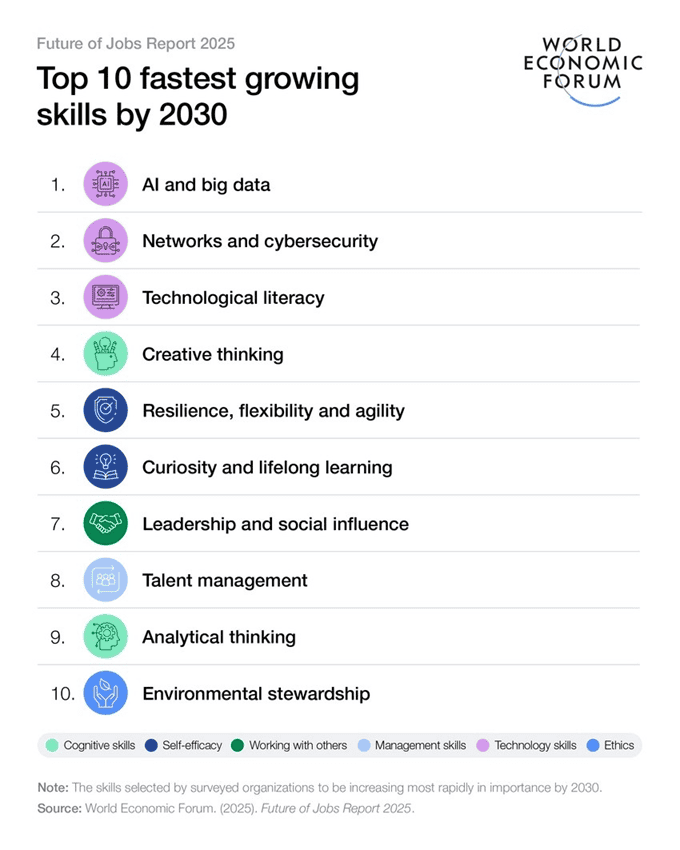
Source: World Economic Forum
The Human Skills That Still Matter
To thrive in an AI-transformed workplace, professionals must build the skills that technology cannot replace. Drawing on insights from the World Economic Forum, here are five core competencies that will shape the future of work:
1. Data Literacy
It’s not enough to have access to data—you must know how to interpret, evaluate, and communicate it clearly. Whether you’re in marketing, logistics, healthcare, or education, data fluency is a baseline skill in modern decision-making.
2. Critical Thinking & Problem Solving
AI can offer options, but humans must evaluate risks, challenge assumptions, and adapt decisions to real-world contexts. These are strategic thinking skills no algorithm can replace.
3. Adaptability & Lifelong Learning
AI is evolving—and so must we. Staying relevant means continuously learning, unlearning, and re-skilling. Upskilling is no longer optional—it’s a mindset.
4. Emotional Intelligence (EQ)
From managing workplace transitions to handling interpersonal dynamics, EQ is where humans shine. AI may provide information, but only people can build trust, resolve conflict, and inspire others.
5. Creativity & Innovation
Whether designing AI-enhanced apps or solving urban challenges, creative thinking is where humans lead. We give meaning, shape narratives, and bring values into technology solutions.
Working With AI, Not Against It
The key message is this: resisting AI won’t future-proof your career—but learning how to work with it will. AI is not here to replace you. It’s a tool to enhance your role, streamline your work, and expand what you can achieve.
Instead of resisting automation, successful professionals will learn how to integrate AI into their workflows. Those who adapt will unlock new levels of efficiency, insight, and creativity. Those who don’t may risk falling behind in an increasingly data-driven job market.
How WOU’s DiGiT Empowers You to Lead
You don’t need to be a coder to succeed in the AI era—but you do need curiosity, initiative, and the willingness to upgrade your skillset.
With online, hybrid, or work-based learning pathways, plus accredited micro-credentials and the APEL fast-track system, these industry-driven programmes offered under our School of Digital Technology (DiGiT) equip learners for the demands of a digital-first economy.
- Bachelor of Digital Business (Honours)
- Bachelor in Software Engineering (Honours) (Application Development)
- Master in Data Science
Explore our flexible, career-enhancing qualifications at wou.edu.my
About WOU
Wawasan Open University (WOU) is Malaysia’s pioneer in flexible online learning, offering full-time or part-time study through 100% online, hybrid, or work-based pathways – designed to fit around your life. Our in-demand programmes and accredited, stackable micro-credentials are complemented by WOU Academy, which partners with industries to deliver customised upskilling and training solutions for workforce development. As Malaysia’s leading APEL (Accreditation of Prior Experiential Learning) institution, we help you fast-track your studies and find the best-fit learning pathway based on your work experience and career goals.