
Artificial intelligence (AI) should not be treated as another tool inserted into processes designed for an earlier technological era. Organisations need to step back, reconsider what they are trying to achieve, and redesign processes around those outcomes.
Wawasan Open University (WOU) Adjunct Professor Leonard Tan, who is Director of Product Operations Engineering at Dell Technologies, underscored this message in his lecture, “The Journey to AI-Native Processes”, examining how organisations can move beyond isolated automation to workflows built around embedded AI.
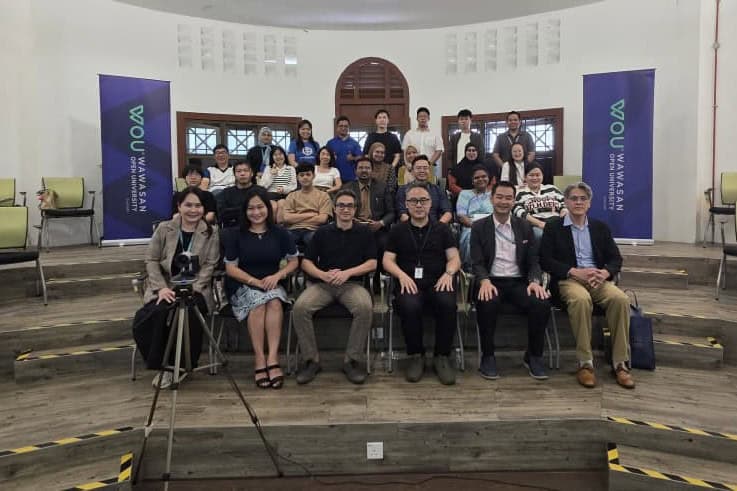
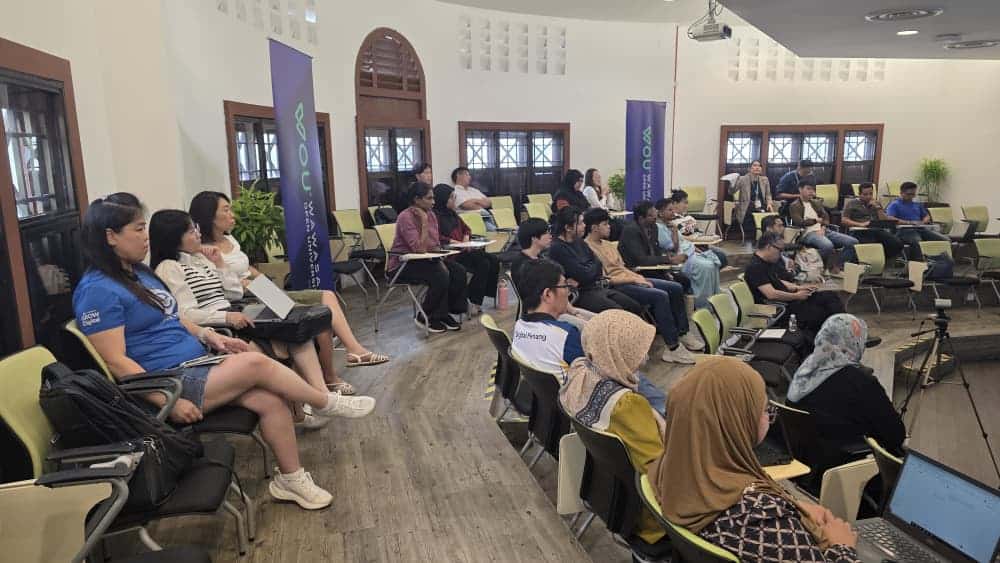
Tan was speaking at the Adjunct Professorial Lecture organised and hosted by the School of Digital Technology (DiGiT) at WOU’s City Campus, Bangunan Wawasan, on 10 July 2026.

Start with the problem, not the tool
According to Tan, the primary shift in technology use today is moving from searching for information to reasoning through complex problems.
“Knowledge has been democratised. We are now in an era of reasoning,” he said. “You do not just ask AI what something is. You ask about the problem you want to solve.”
As many operational processes were designed around legacy technologies, adding AI without reconsidering how those workflows function risks reproducing old limitations in a new form.
Tan urged organisations to open up the operational blueprint, examine their ultimate objectives, and rethink the underlying process rather than simply inserting AI into existing steps.
He illustrated this through the example of an AI-enabled drive-through ordering system. Replacing a human order-taker with an AI agent might appear efficient on paper, but if the wider customer journey remains unexamined, the system can still generate errors, delays, and frustration.
A more effective design connects ordering, location tracking, network access, preparation time, and collection into a cohesive loop. The aim, Tan explained, is not to automate one isolated task, but to improve the complete process and the outcome it delivers.
Capability must lead to scalability
Tan stressed that developing a successful proof of concept is only the beginning.
“It is not just about activity and capability. We have to talk about scalability,” he said.
A model may perform well with a small spreadsheet, but its accuracy can deteriorate when faced with thousands of records or hundreds of pages of frequently changing documentation. Scaling an AI solution, he explained, depends heavily on data engineering, database design, embeddings, governance, and information quality.
“Data engineering is crucial. If you do not manage your data properly, you are going to get it wrong,” he said. “You cannot put in 400 pages of documentation or 50,000 rows and simply hope that it will work.”
Furthermore, much of an organisation’s most valuable knowledge remains trapped in employees’ heads, scattered across disparate systems, or recorded without enough context to be useful later. A status marked simply as “done”, Tan noted, fails to explain the root cause, how the issue was resolved, or how to prevent it from recurring.
By converting tacit knowledge into structured information, organisations can build an institutional memory that is easily searchable and reusable. An AI agent can then retrieve relevant past cases in seconds, replacing hours or days of manual record review.
Select the Right Tool for the Job
As AI deployment enters a more cost-conscious phase, Tan advised organisations to match the model to the specific use case rather than defaulting to the most powerful option.
“Why use an expensive model for a simple task? Use the right model for the right use case,” he said.
He shared how his team achieved encouraging results with free or lightweight tools during prototyping, reducing work that previously took three weeks to about three days. While simple tasks may not require an advanced paid model, more specialised applications could demand stronger tools, better data preparation, or a different technical approach.
Tan also cautioned against assuming that every problem requires generative AI. He stressed that the starting point must be a clear understanding of the problem.
Depending on the circumstances, the most effective solution could involve AI, conventional automation, machine learning, better standardisation, or improved data management.
Leadership must learn by doing
During the question-and-answer session, Tan identified leadership as one of the biggest barriers to AI transformation.
“If a leader does not understand how it works, it is very difficult to design the direction, articulate it, or create a learning path for the team,” he said.
Leaders need to experiment with the technology directly to understand its strengths and limitations firsthand. He encouraged organisations to create governed spaces where employees could test ideas, build prototypes, and demonstrate value before moving solutions into production.
Addressing common anxieties surrounding automation, Tan challenged the belief that AI would inevitably eliminate jobs.
“Replacing a task does not mean the job disappears,” he emphasised.
By automating repetitive testing and analysis, Tan’s own team gained more time to engage with product groups, collaborate across functions, master new capabilities, and focus on solving more complex problems.
Tan concluded his lecture by encouraging participants to make full use of the technical knowledge, open-source tools, online courses, and learning opportunities already available, and to build their understanding through practice.