
Roundtable hosted jointly by Wawasan Open University and the George Town Institute of Open and Advanced Studies
Industry leaders, technology researchers and academia gathered at Wawasan Open University (WOU) on 4 December 2025 for a high-level Industry Roundtable hosted by the George Town Institute of Open and Advanced Studies (GIOAS), the non-profit institute within WOU that seeks to explore ideas and complexity within open societies. Participants examined the strategic priorities Malaysia must address to remain competitive in the age of artificial intelligence (AI) and advanced semiconductor design.
The Roundtable took place against the backdrop of Malaysia’s National AI Technology Action Plan 2026–2030, which places human capital, innovation, and ecosystem development at the centre of intelligent-industry growth. With multiple agencies and institutions advancing different parts of the semiconductor and AI agenda, speakers underscored the value of closer public–private–academic coordination to avoid fragmentation and unlock synergies.
Malaysia is experiencing strong momentum in the global semiconductor boom, with Penang and the Northern Corridor anchoring a major share of national output. At the same time, AI-driven chip design, geopolitical pressures, tariff volatility, and increasing demand for multidisciplinary engineering talent are reshaping the industry’s future. Speakers agreed that Malaysia must take a long-term and coordinated approach to secure its technology and innovation capability over the next decade.
A central focus of the discussion was how Penang can evolve from manufacturing excellence to leadership in high-end design, AI-integrated engineering, and deep-tech research. Speakers highlighted that these higher-value activities, especially in co-creation using AI tools, will determine competitiveness in the intelligent-industry era.
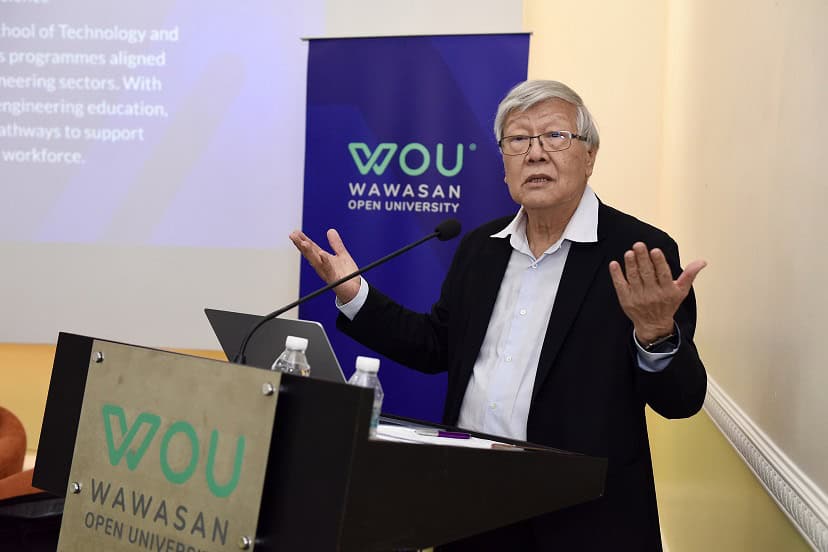
The Roundtable, moderated by GIOAS Chairman Tan Sri Andrew Sheng, featured perspectives across chip design, advanced manufacturing, university research, and creative-technology applications of AI, with panellists:
• Dr Kewei Yang — Co-founder of Analogix Semiconductor Inc, Silicon Valley technologist and deep-tech innovator behind global semiconductor deployments
• Mr Leonard Tan — Director of Product Operations Engineering at Dell Technologies specialising in automation, analytics and smart-factory transformation
• Mr Ong Chin Hu — Founder/CEO of GreatASIC Technology with extensive experience in SoC, IP and semiconductor innovation
• Mr Tan Li Jia — Penang-born creative technologist and AI-assisted art director at Riot Games leading global design teams
• Assoc Prof Ts Dr Sean Tan Koon Tatt — Dean of WOU’s School of Technology & Engineering Science, specialising in applied AI and industry-linked talent development
Together, the speakers represented the full value chain — from semiconductor design and automation to AI-enabled creative technology and engineering education — offering an in-depth yet holistic view of what Malaysia will require to remain competitive in the intelligent-industry era.

Key points were raised regarding Penang’s semiconductor industry and Malaysia’s strategic position:
Playing to existing strengths
At USD 1 billion to design a single 3-nanometre chip, wafer fabrication remains too investment-intensive for Malaysia to compete at the integrated device manufacturer (IDM) level. As a small country unable to scale globally, Malaysia must make strategic bets on specific niches where she has comparative advantage. The consensus centred on IC design, outsourced semiconductor assembly and test (OSAT), advanced packaging, and testing which are areas where Penang already demonstrates strength through both local companies like Inari plus key multinationals, such as Intel, HP and other major global semiconductor players already located in Malaysia.
Talent retention
The Roundtable kept returning to the key crisis of talent, as Penang produces strong technical talent but consistently loses it overseas. Dr Yang, drawing on 30 years in Silicon Valley and China semiconductor industry development, described how the intimate relationship between top Californian universities and the industry in Silicon Valley, plus manufacturing in East Asia, created a consistent generation of talent, emphasising the role of education institutions in talent retention and creation.
Mr Ong elaborated that hiring established top global talent is prohibitively expensive, which heightens the risks and costs of investing in the wrong product or process. With Vietnam emerging as a serious competitive threat, the urgency extends to attracting fresh regional graduates through university partnerships and immigration policy reforms.
Tan Li Jia shared his experience as a young Penang-born artist educated in Los Angeles who got involved in creative game production and leveraged on creativity and project management under different cultures to succeed.
Supply chain advantage under threat
Dr Yang emphasised that Penang’s long integration into global supply chains provides an advantage that newer competitors cannot easily replicate. However, this same advantage is eroding. Industry representatives in the audience warned about India’s aggressive semiconductor incentives, with central and local governments effectively providing 75% no-strings-attached capital. Penang’s market share faces direct threat as India scales manufacturing.
Mr Leonard Tan emphasised how AI is transforming the ability of companies to upgrade productivity in software and manufacturing process management. He emphasised the need for intrapreneurs (in-firm risk-takers) in order to nurture entrepreneurs (value-creation at the industry and sector levels).
Mobilising finance
Mr Ong described how Malaysian venture capital has historically sought short-term returns appropriate for service businesses, failing to understand that product design in semiconductors requires patient capital over much longer horizons. Malaysia holds only 10% of its market capitalisation in technology, with minimal deep tech investment, compared to 50-60% in the United States.
Dr Yang contrasted this with Silicon Valley’s approach, where venture capital bets on long games, without fear of failure. Tan Sri Andrew emphasised that beyond availability, accessibility of funds matters, because only by creating the eco-system of talent, supply chain, research and development and adequate risk-taking capital, can Malaysia replicate the Silicon Valley model.
By the end of the Roundtable, the question of whether Penang needs a semiconductor institute became less about education and more about strategies for survival. As global semiconductor and AI markets prepare for sixfold growth to USD 15 trillion over the next decade, industry veterans warned that while Malaysia possesses excellent advantages in the semiconductor chip supply chain, if it cannot coordinate talent, capital, and policy, Malaysia risks losing ground to competitors like Vietnam and India, which have engineering talent and strong government backing.
The Semiconductor Institute Proposal
Regarding a potential semiconductor or advanced manufacturing institute in Penang, panellists outlined how such an entity could cut across multiple agencies to strategically address systemic issues.
Potential roles for a dedicated semiconductor institute could include a platform to help educate startups, incumbent firms, government agencies, and potential funds on co-creating the necessary eco-system so Penang and Malaysia can play to their strengths. This would include tapping regional talent through regional university linkages, and advising on immigration policy for foreign talent recruitment.
Assoc Prof Ts Dr Sean Tan added that microcredentials could offer pathways for both current and future workforce development, emphasising that education systems must gear toward high-value job creation, including drawing more on industry know-how to teach, mentor and drive re-skilling staff and new entrants to the job market.
However, participants raised that the best research institutes are those that are industry-led and industry-funded rather than government-driven. One industry voice emphasised that competition today is actually between entire supply chain clusters, rather than competition between individual companies. There was support for more urgent and greater deliberation between academia, business, and government to ensure that the country responds rapidly and nimbly to quick-changing market conditions and competitive threats.